FROM first steps at three years old to dancers returning to classes decades later, Highland dancing continues to thrive across Cowal and Bute – with the Cowal Gathering helping inspire each new generation to take to the boards.
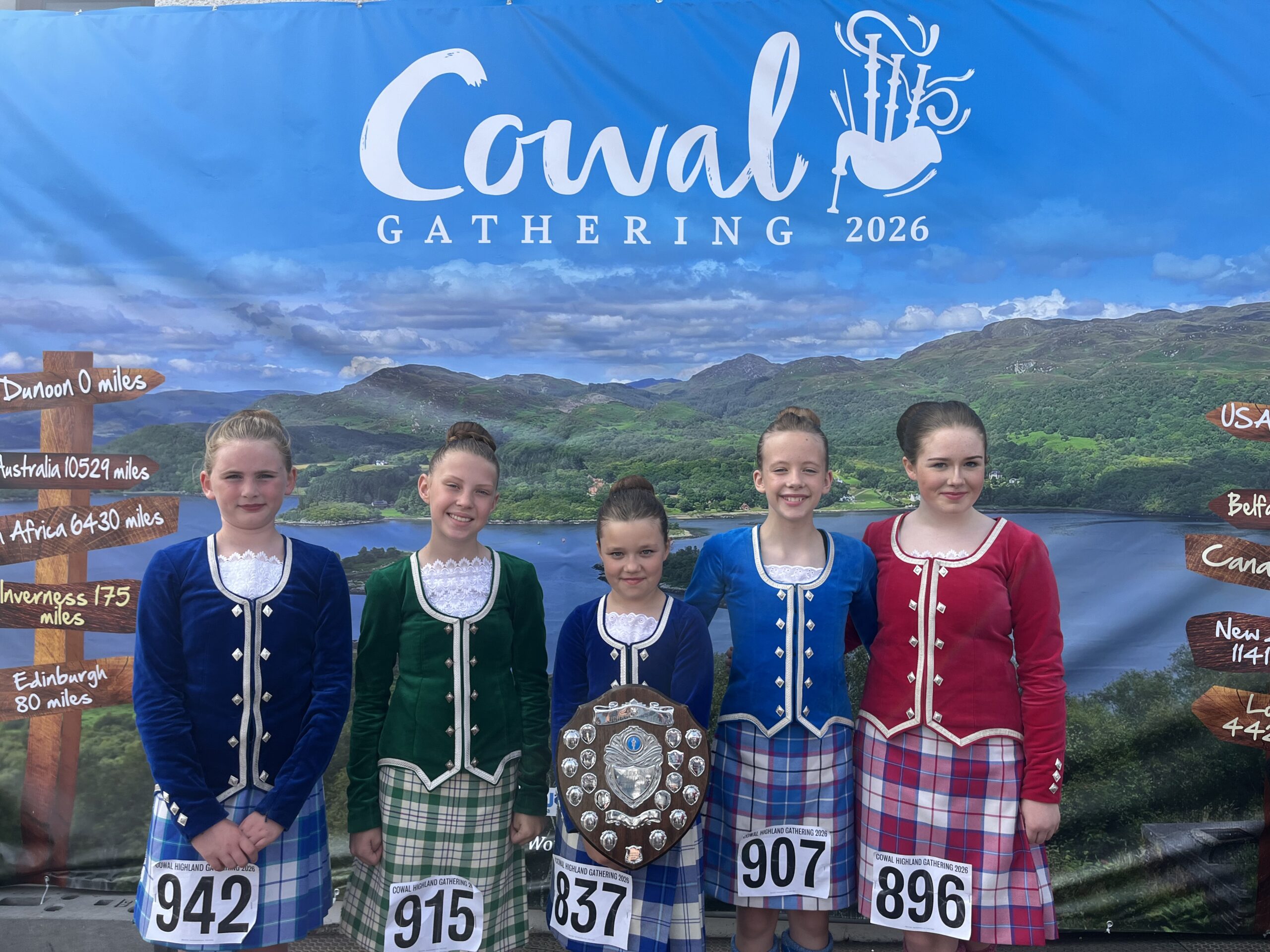
The strength of Highland dancing across Cowal and Bute was on full display at this year’s Cowal Gathering, with local dancers appearing throughout the three-day competition and returning home with an impressive collection of medals, trophies and championship placings.
But behind the results is a story which stretches much further than one Gathering weekend.
Across Dunoon and Bute, dozens of children and young people continue to attend weekly classes, while many compete throughout the year and travel considerable distances to take part in competitions.
And while teachers say pupil numbers have remained remarkably steady, there are signs of another interesting trend – former dancers are pulling their pumps back on and returning to classes.
For Dunoon teacher Katrina Martin, it is part of a cycle she has now watched come full circle.
Katrina has been teaching in the town for 26 years and some of the youngsters she taught when she first opened her school are now bringing their own children to her classes.
“I currently have 25 competitive pupils within the team,” she said.
Although numbers have roughly stayed the same over the past few years, what has changed is retired dancers returning to classes either to compete or for fitness.
Nowhere is that passing of Highland dancing from one generation to another more evident than on Bute.
Dance teacher Chloe Aiken estimates there are now more than 100 dancers across the island’s three Highland dancing schools – all of which share a remarkable connection.
Anne McIlroy was just 14 when she won the World Highland Dancing Championship at Cowal in 1956.
The following week, she began teaching Highland dancing on Bute.
She continued teaching generations of island dancers until her death in April 2020, with all three of Bute’s current Highland dance teachers among her former pupils.
Chloe Aiken began dancing with Anne at the age of four and said her former teacher’s influence extended far beyond learning steps and preparing for competitions.
“Over the years she taught many dancers on the island, who then went on to have their own children and grandchildren who also danced,” Chloe said.
“She became more than just a dance teacher and felt like an extra family member.
“Her passion, commitment and love for dancing is definitely the legacy she’s left behind on our island. A special lady, who made us all fall in love with Highland dancing.”
Chloe established her own school four years ago and now teaches 48 dancers ranging in age from two to 18.
Having worked in a nursery, she began accepting two-year-olds in 2024 and says the class has proved particularly popular.
She believes youngsters seeing older dancers performing at Bute Highland Games and Cowal Gathering encourages them to have a go themselves.
Inspired by Cowal
It is a pattern repeated across the Clyde in Dunoon.
Christina Cairns teaches just under 40 pupils, with numbers remaining fairly steady over recent years.
She believes one of the biggest attractions for youngsters is seeing their friends dancing and watching local performances, particularly during Cowal Games week.
Her pupils perform at Kirn Gala and the Sunset Ceremony before taking part in the March Past on Cowal Saturday – allowing even those too young or not yet ready to compete to experience performing in front of a crowd.
“My pupils absolutely love the above and, of course, it gives my pupils, who are still not ready to compete or are too young, the chance to join in the fun and excitement of performing to a crowd, feeling very much part of a team too,” Christina said.
Katrina has seen the same Cowal effect during her 26 years of teaching.
“After Cowal there is certainly an intake of new excited wee dancers that have seen dancers perform on the famous Cowal boards and now they want to try,” she said.
And the interest is not confined to girls.
Katrina recently visited a local primary school and said both boys and girls were fascinated not only by the dancing, but by seeing the kilts, dancing pumps and swords used by competitors.
On Bute, teachers also point to youngsters seeing friends and family members dancing, while social media and high-profile displays such as military tattoos are giving Highland dancing greater visibility.
If watching Cowal encourages children to start, competing there becomes the ambition once they do.
“Cowal is the championship that every Highland dancer works hard all year for,” Katrina said. “Our dancers learn from a young age that if they work hard then one day they will progress into the championship level and perform on the famous World boards and aim to win a Cowal medal – or even better, a trophy.
“There is definitely something special about dancing on the main boards at Cowal – that feeling never leaves you.”
Christina said competing on home ground can bring additional pressure, but also makes success particularly special.
“Dancing on home ground is very special and means so much to win a Cowal medal or trophy,” she said.
“It can also come with the pressure of wanting to do well for that very reason too, but ultimately it is a wonderful feeling, especially for first-time competitors, to be able to say, ‘I danced at the Cowal Games.’”
The Speirs School of Highland Dance on Bute, which has around 30 pupils, summed up the progression simply.
“Dancing on the Cowal boards is what every young dancer dreams of once they start competing,” teacher Margaret-Anne Speirs explained.
“Then it is to get a Cowal medal, then qualify for the Worlds.”
And plenty of those dreams became reality this year.
The Speirs School had 15 dancers competing across the three days of the Gathering – and, remarkably, every one achieved a placing.
Among them was Rothesay’s Lucy Cameron, who took third place in the Scottish National Championships before qualifying from the Adult World Championship heats, earning her place among the dancers competing in Saturday’s World Championship.
She became the first dancer from the Speirs School to qualify for the Worlds.
The Chloe Aiken School also enjoyed success across the competition levels.
Leya McMillan and Kady Brooks represented the school at Novice level; Cozy Allan, Poppy Gray, Aurora Pattison and Lola McMillan competed at Intermediate; while Layla McFarlane, Ashlyn Williamson, Sophie Mellor and Isabella Gray competed at Championship level.
Leya finished runner-up in the nine years and under Novice competition, while her older sister Lola took third place overall in the Intermediate section.
Sophie Mellor finished fourth overall in the 12 and 13 years Argyll Championship, with Isabella Gray fifth – the first time Isabella had made a championship line-up.
Chloe said she was equally proud of what happened away from the results board.
“They danced amazingly, had great results to show for it and, most importantly, acted as an incredible team, supporting each other, picking each other up when needed and cheering each other on,” she said.
Christina Cairns’ pupils Lois Cook and Leah Hobday were among the school’s trophy winners, with Georgia taking first place in her section of the pre-premier Argyll Trophy.
The local dancing scene is not confined to youngsters chasing competition medals.
Katrina’s school has a pre-premier class from age three upwards, championship and competition classes covering mixed ages and a fitness and stamina class which has attracted former dancers back into the studio.
And this year’s Gathering may have provided another incentive.
Cowal introduced a new adult Argyllshire competition for 2026, which Katrina says has already sparked interest among retired dancers considering a competitive return.
There is a similar story on Bute. The Anne McIlroy School has previously run an adult class whose oldest pupil was 67 – with the school’s first pupil from 1956 also attending.
Some of its current dancers compete most weekends and several are preparing to travel to Basel later this year, while the school’s dancers also sat dancing examinations earlier this year.
Former pupil Eilidh McTaggart, meanwhile, began dancing at the age of four and started at Glasgow University this month. One of the first things she did was find a group of Highland dancers at university so she could continue.
Taken together, the schools’ experiences suggest that Highland dancing in Cowal and Bute is not experiencing a comeback – because it never really went away.
Children see dancers at Cowal, Bute Highland Games, Kirn Gala or the Sunset Ceremony and decide they want to try it themselves. Some become competitors, some reach championship level and others eventually become teachers.
Years later, some return for fitness – and others walk back through the door with their own children.
Seventy years after a 14-year-old Anne McIlroy became World Champion and began teaching on Bute the following week, the dancers she inspired have themselves become teachers and are passing that tradition to another generation.
For Chloe, that continuity matters more than any medal.
“Above all, I hope I can pass onto my dancers what Miss Anne passed onto me growing up – a love for dancing,” she said.
“Beyond the results, I believe that will always be the most important part.”
And, as Katrina’s experience after 26 years of teaching in Dunoon demonstrates, today’s excited youngster watching the dancers on the Cowal boards may well be tomorrow’s competitor – and, one day, the parent bringing another new dancer through the door.