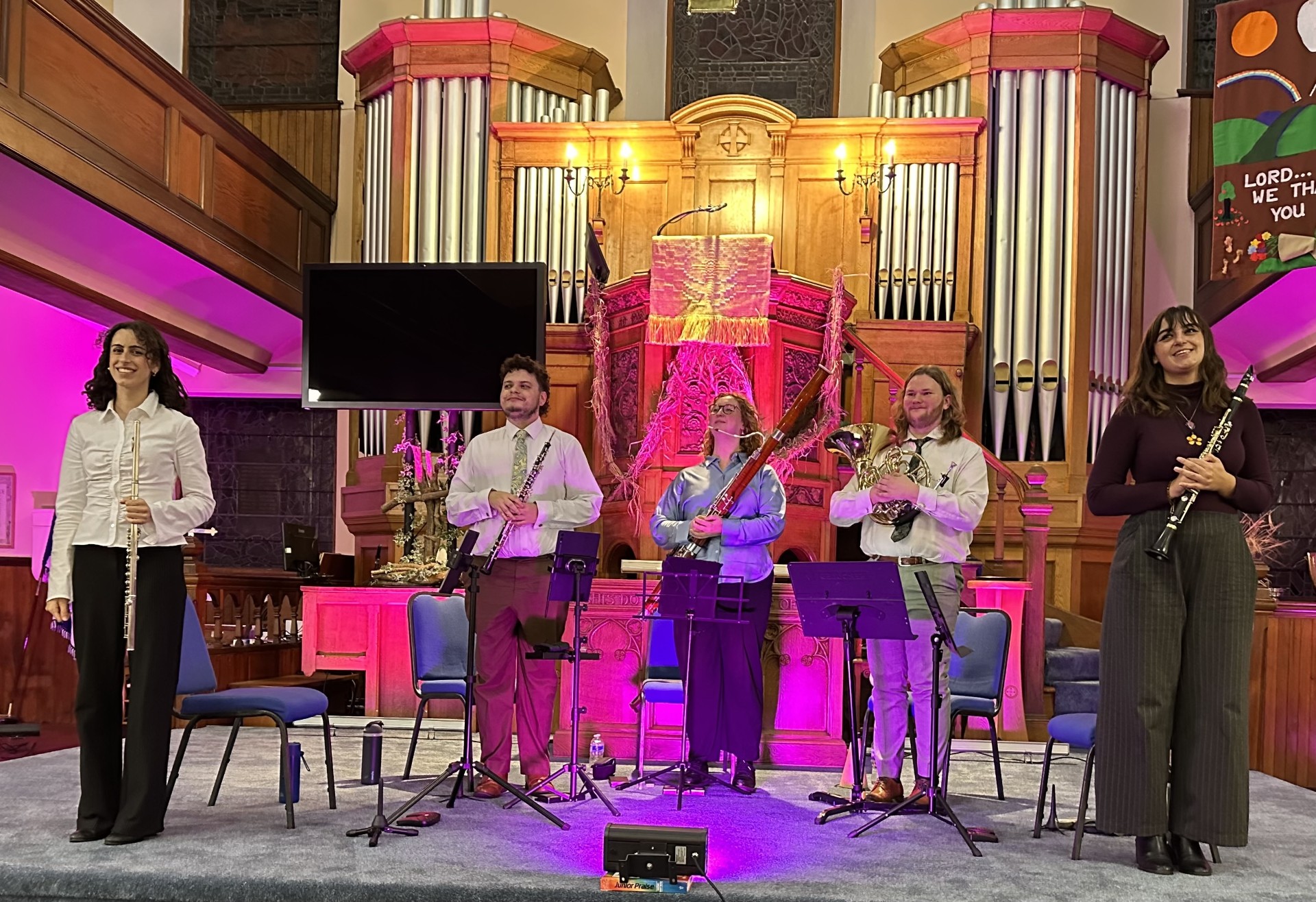
BUTE ARTS Society revived a historic connection with South Wales by bringing the Bute Wind Quintet to the island for an evening of music.
The quintet takes its name from Bute Park in Cardiff, which overlooks the Royal Welsh College of Music and Drama, where the ensemble’s members were formerly students.
The young ensemble comprises flautist Gabriella Alberti, oboist Sam Willsmore, bassoonist Hannah Harding, clarinettist Meg Davis and horn player James Chesney.
The group is committed to championing the diversity of music written for the wind quintet line-up and has performed extensively at festivals and venues. It recently completed a two-year artists residency at the Norwegian Church Arts Centre.
Individually, members have also freelanced with professional orchestras including the BBC National Orchestra of Wales, Welsh National Opera and Bournemouth Symphony.
Their programme, ‘A Parisienne Affair’, featured music from a selection of 20th-century, predominantly French, composers.
The evening began with Darius Milhaud’s Cheminee du Roi Rene, Op. 205, written in 1939. Described as a collection of ‘medieval miniatures’, the bright and jaunty work comprised seven sections.
Highlights included Cortège, portraying the titular king of Sicily walking through Provence, while Aubade gave the flute an opportunity to produce birdlike sounds.
La maousinglade featured a rich oboe theme, while Chasse à Valabre took on a cheerful gallop evoking a hunting horn before the work concluded with the peaceful Madrigal nocturne.
The programme continued with Francis Poulenc’s Novelette in C major, originally written for piano in 1927 and arranged for the quintet by Emerson.
The neo-classical, song-like melody and contrasting central section were joyously performed, with the full-bodied arrangement making the most of the tonal strengths of the five instruments.
Henri Tomasi’s ‘Variations sur un thème Corse’ followed.
The lyrical and melodic work, inspired by Tomasi’s childhood holidays in Corsica, transformed its opening Andantino theme through six variations.
It provided opportunities for musical conversations between different pairs of instruments, including flute and clarinet and later bassoon and clarinet, while the bassoon was given several cheerful passages.
Maurice Ravel’s ‘Tombeau de Couperin’ then brought a more reflective mood.
Composed between 1914 and 1917 in the form of a traditional Baroque suite, each movement was dedicated to someone Ravel had known who had died in the Great War.
The work was intended to be reflective rather than sombre, with Ravel observing that ‘the dead are sad enough in their eternal silence’.
The six movements began with a Prelude featuring a fluttering, birdlike melody on the oboe. The fugue was pared back and elegant, while understated horn playing enhanced the piece before it concluded with the playful, dancing toccata.
Jacques Ibert’s ‘Trois Pièces Brèves’ followed, a work which evolved from music he had composed for the theatre.
Its three sections demonstrated Ibert’s theatrical approach, beginning with an energetic jig before moving into a gentle and delicate andante which interwove the flute and clarinet.
The final assez lent – allegro scherzando took the audience on what was described as a wild carousel of sound.
Paul Taffanel’s ‘Quintet in G minor’, dating from 1876, provided an evocative change of pace, with a relaxed and lyrical andante eventually building towards an exuberant tarantella finale.
As Taffanel was himself a flautist, the instrument flourished throughout the work.
The evening concluded with Vaughan Williams’ ‘English Folk Song Suite’, composed in 1923.
A former pupil of Ravel in Paris, Vaughan Williams drew on folk songs collected by Cecil Sharp, with the three sections culminating in the march folk songs from Somerset.
Audience members happily recognised Blow Away the Morning Dew and John Barleycorn.
The audience was enchanted by the unusual programme and the quintet’s energetic and spirited performance.
It was, however, a shame that more people had not attended to experience the young ensemble’s impressive performance.