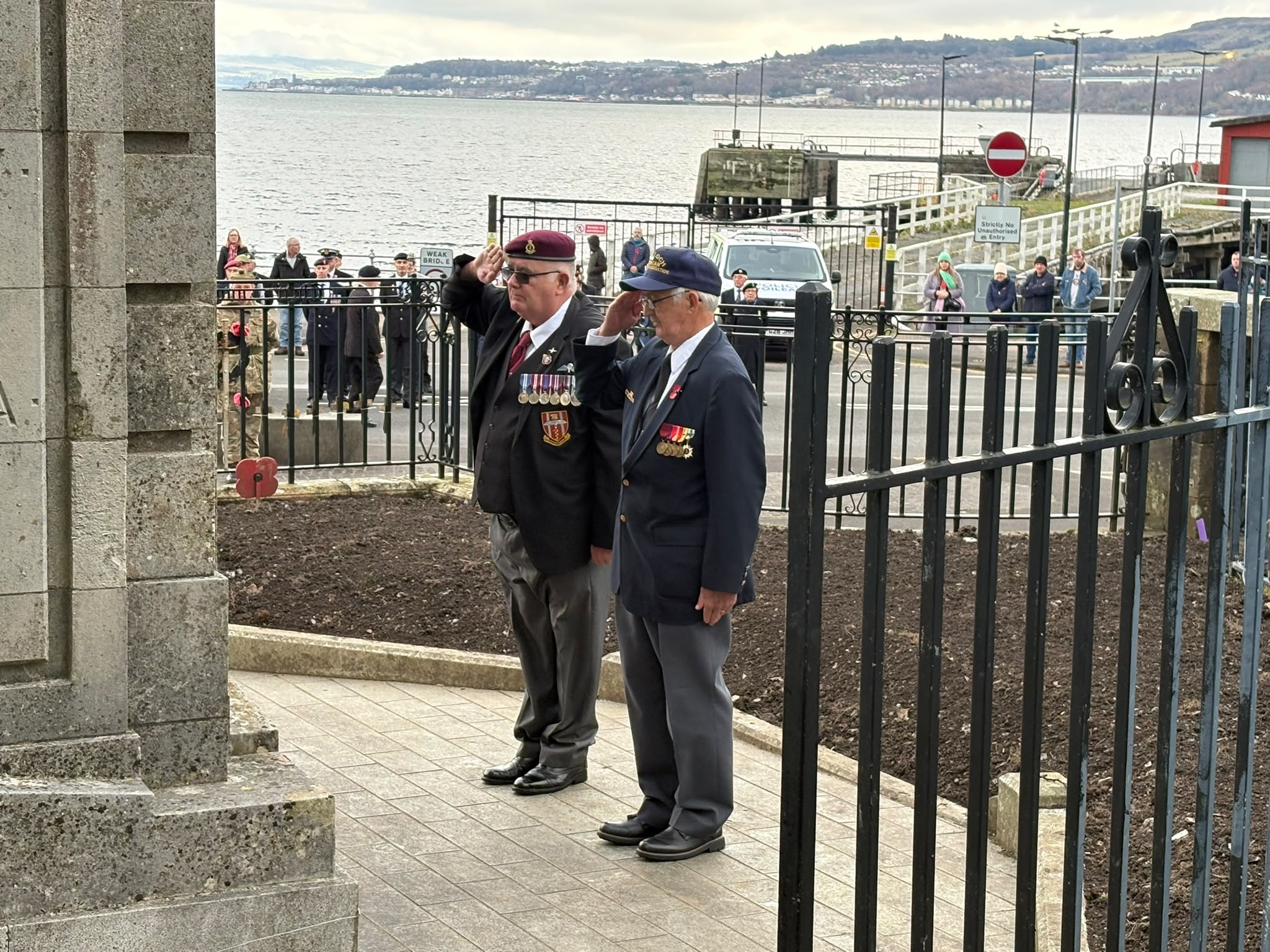
COMMUNITIES across Cowal and Bute came together on Remembrance Sunday to honour those who lost their lives in war and conflict.
Services of remembrance took place in Dunoon, Sandbank, Innellan, Tighnabruaich, Rothesay and Inveraray, as people gathered to pay their respects and reflect on the sacrifices made by generations of servicemen and women.
The commemorations were held in cold but dry conditions, a stark contrast to last year’s heavy downpours, which saw those attending services having to brave the rain.
From Dunoon and the surrounding Cowal villages to the Isle of Bute and Inveraray, the commemorations demonstrated the enduring importance of Remembrance Sunday in communities throughout Argyll.
At this year’s Remembrance Sunday service at Dunoon War Memorial, Rev Janet K. MacKellar delivered a moving address reflecting on the town’s wartime history, the personal sacrifices made by local families and the importance of preserving the memory of those who never returned.
She recalled how Dunoon’s peaceful waterfront had once been transformed by the Second World War, when the Firth of Clyde became a busy route for naval convoys. The town also played an important role in providing refuge, welcoming children evacuated from Glasgow during the Blitz into local homes.
Rev MacKellar highlighted the devastating impact of both world wars on Dunoon, recalling generations of young men, including former Dunoon Grammar School pupils, who left their hometown never to return.
Among the stories she shared was that of Walter Smith, who witnessed the extraordinary Christmas Truce of 1914, when opposing soldiers briefly put aside their weapons and fraternised, including playing football. According to the account shared during the service, Walter was killed by a German sniper on Christmas Day after an accidental shot brought the brief ceasefire to an end. He is remembered as possibly one of the first soldiers to lose his life following the truce.
The address also recalled the grief experienced by local families, including missionary James MacFarlane, whose religious faith helped sustain him through personal loss.
Particular attention was given to the tragic story of brothers Archie and Jack McKellar, both of whom lost their lives during the First World War.
Archie was born at Bowmore Cottage in Dunoon, the younger of two sons in a family of eight children. He attended Dunoon Grammar School, belonged to its Cadet Corps and later worked as a bank clerk at the Union Bank of Scotland in the town. The family lived at Esplanade House in West Bay, only a short distance from the war memorial.
When Britain entered the war on August 4, 1914, Archie enlisted in Dunoon that very day, aged just 20. His brother Jack was already serving with the Argyll and Sutherland Highlanders Territorial Army.
Both brothers subsequently lost their lives, Jack aged 25 and Archie just 24, leaving their family to endure the loss of two sons.
Rev MacKellar also drew attention to the many names inscribed on Dunoon’s war memorial, including Donald Ainsworth, Donald Beaton, John Beaton, George Beattie and William Begbie.
She recalled how local servicemen had served in regiments and forces including the Argyll and Sutherland Highlanders, Gordon Highlanders, Black Watch, Royal Navy and Commonwealth forces.
Others, including William Carswell, Donald MacKenzie, Harry McNeil and Robert Steven, had carried their connections to Dunoon to battlefields far from home.
Throughout her address, Rev MacKellar emphasised that the names on the memorial represented far more than a record of wartime losses. Each belonged to an individual with a family, a future and hopes that were cut short by conflict.
She concluded by reflecting on the values of courage, duty, sacrifice and service, encouraging those gathered to honour the fallen not only through remembrance, but by working towards peace and showing the same compassion and hospitality that Dunoon demonstrated during the darkest days of war.
Although the weather was chilly, the dry conditions offered a welcome respite from the rain that marked last year’s commemorations.
As another Remembrance Sunday drew to a close, the message across Cowal and Bute remained one of gratitude, reflection and a commitment to ensuring that the sacrifices of the fallen are never forgotten.