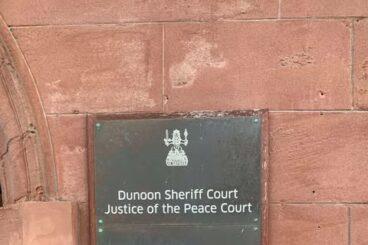
THE FORMER secretary of Dunoon Community Council has strongly criticised a recent sentence handed down at Dunoon Sheriff Court for possession of a banned knife, while also questioning the effectiveness of community payback orders in the town.
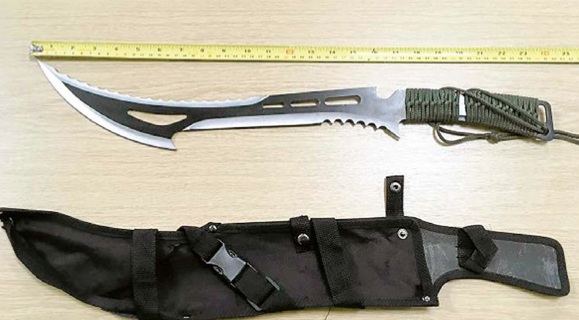
As reported in this newspaper last week Robert Crombie (48), was fined £335 after he was found to be in possession of a banned ‘Zombie’ knife in Cowal Place on July 7, 2025.
Zombie knives are currently banned across the UK amid concerns about their association with serious violence and knife crime. The weapons are generally characterised by large blades often inspired by those seen in horror films and video games.
In a statement Mr McCowan, whostepped dwon from Dunoon Community Council, (DCC), this week, explained his growing frustration with what he described as an ‘increasingly ineffective criminal justice system in Scotland,’ and heavily criticised the sentence given to Robert Crombie.
He said: “This case raises some very serious questions. What message does this send to the public, particularly our younger generation?
“These weapons are not carried for decoration. They are extremely dangerous, and the consequences of one being used could be devastating, potentially resulting in serious injury or loss of life.
Both the Scottish and UK Governments repeatedly tell us how seriously they take knife crime. We hear constant promises of tougher action, stronger deterrents and safer streets. Yet when someone is caught carrying such a weapon, the punishment amounts to little more than a financial penalty.”
“Given the nature of the weapon involved, I believe the public is entitled to ask why a custodial sentence was not considered appropriate in this case.”
The former secretary of DCC went on to question the effectiveness of community payback orders, where offenders are sentenced to carry out unpaid work around the local community, commonly known as ‘community service.’
He explained: “Week after week, we read about individuals being sentenced to community payback orders. However, I have to ask, where is the visible benefit to our community?
“Take a walk along Dunoon’s promenade and look at the weeds growing through the paving. Visit Argyll Gardens and see the condition of what should be an attractive public space. Look at the state of some of our public litter bins, recently highlighted on the local Facebook group Dunoon Argyll Scotland.
“These are all areas where supervised community payback work could make a genuine and visible difference.Why are suitable offenders not being tasked with removing weeds, cleaning public bins, tidying communal areas and helping restore some pride in our town?”
Mr McCowan acknowledged the financial pressures and limited resources facing Argyll and Bute Council, arguing that the local authority should not automatically be blamed for maintenance issues when budgets and staffing were already stretched.
However, he suggested that community payback orders could help address some of these problems, with offenders carrying out unpaid work that delivered tangible benefits to local communities.
While recognising that community payback work was already taking place, potentially away from public view, he called for greater visibility and transparency to reassure residents that sentences were being enforced and making a meaningful difference.
He said: “When repeat offenders receive what many will regard as lenient sentences, and when community payback orders appear to produce little visible improvement in our communities, it is hardly surprising that ordinary, law-abiding residents become disillusioned.
“We need a criminal justice system that takes dangerous weapons seriously, imposes meaningful consequences for offending and ensures that community sentences genuinely benefit the communities they are supposed to serve.
“Dunoon deserves safe streets, well-maintained public spaces and a justice system in which its residents can have confidence. Surely that is not too much to ask?”