Tuna, a loggerhead turtle and even a swordfish add to mounting evidence of unusual sea life around Cowal and Bute
THERE’S BEEN footage, sightings and even a discovery – a collection of evidence to suggest that something unusual is happening in our local waters.
A variety of rare marine life, mainly foreign to this area have recently been recorded by members of the public and experts are as fascinated by the sightings as those who have filmed them.
Last month a blue fin tuna was spotted off the coast of Rothesay and filmed by a couple on a yacht. The fish was around eight foot in length and followed the vessel for a while before diving deeper underwater.
John and Calyn Stirling initially thought they had spotted a shark, but when the fish surfaced, its bright yellow spikes confirmed it was a tuna.
Sightings of bluefin and bonito tuna have become more common in Scottish waters in recent years, linked to warming sea temperatures and recent sightings of blue fin tuna in the Holy Loch adds to growing evidence of the fish returning to Scottish seas, although fishing for them remains tightly regulated.
Last weekend footage emerged of a small, loggerhead sea turtle spotted around Bute harbour. Loggerheads are rare visitors to our waters and authorities were contacted but unfortunately by the time they arrived the turtle had vanished. In 2022 another juvenile loggerhead was washed up on Iona, and had to be rescued and rehabilitated.
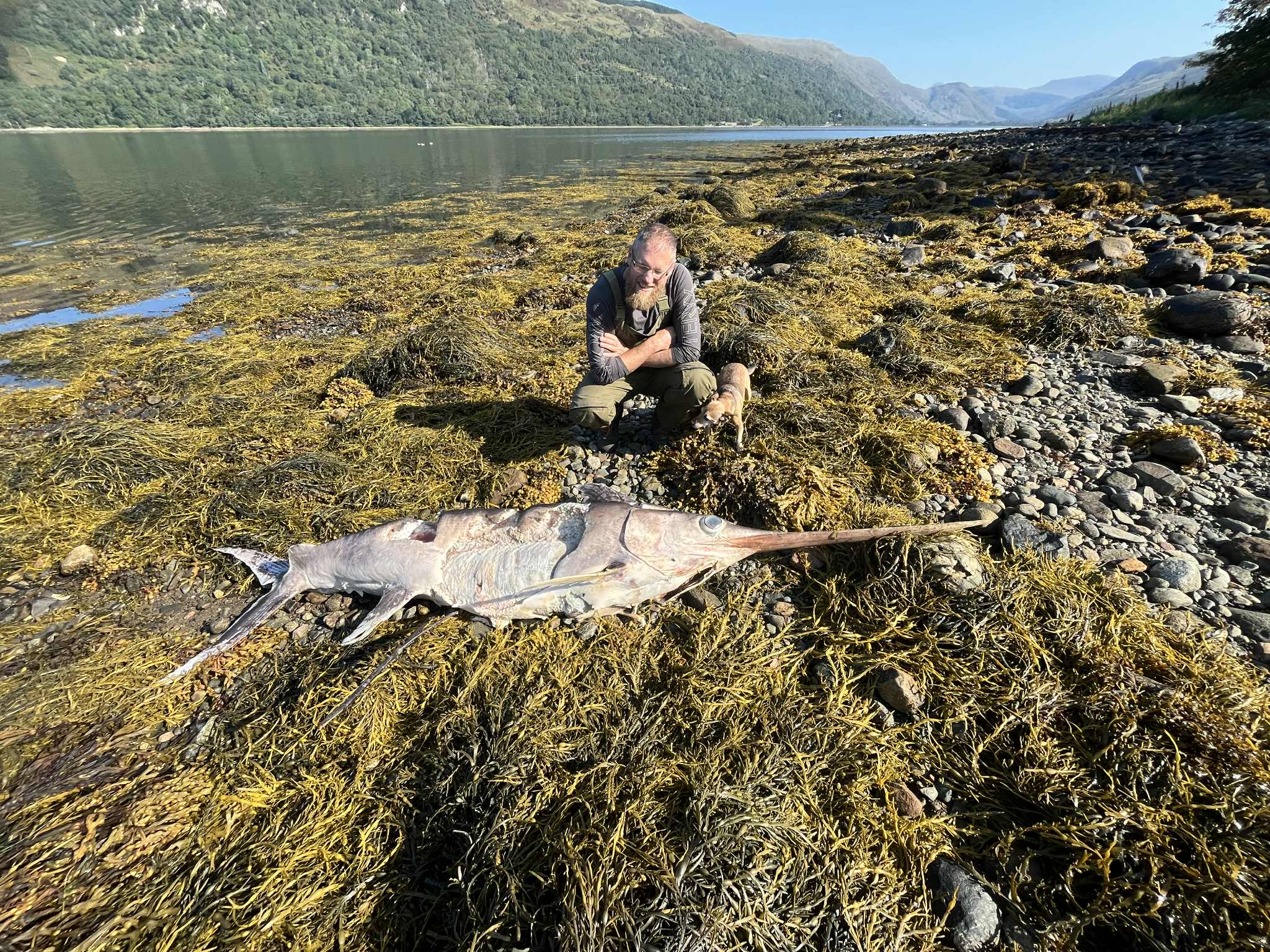
However, the most noteworthy recent record of unusual and rare marine life in our waters occurred earlier this month, when the carcass of a swordfish was found on the shores of Loch Fyne.
Jason Ferguson, the wildlife manager on Ardkinglas estate at Cairndow was involved in its retrieval, he explained: “A member of the public found it, not sure who. They reported it to Scottish Marine Animal Stranding Scheme, (SMASS). Graham McKirdy from Strachur came out and I was able to help him locate the grid reference of the swordfish. When I met Graham he said a dead swordfish had been reported but he was expecting it to be a porpoise or dolphin as a swordfish would be very unusual. He and I were both very surprised that it was actually a swordfish. Assisted by Graham I fetched the Ardkinglas estate tractor and a pallet and we roped the animal with the tractor on to the pallet and then took it to a location where it could be loaded onto the national museum of Scotland’s transportation vehicle.”
Surprisingly this wasn’t the first time an incident of this nature had occurred. Back in 1994 a similar sword fish was washed up at the head of Loch Fyne and was found by Alastair MacCallum and Rab Petrie, although this is evidence of something which has happened before, it’s still extremely unusual.
Jason explained: “It is not unheard of for exotic marine species associated with more southern latitudes to turn up in Scottish waters. I understand there has been some quite natural shifts in the Gulf Stream in recent years which is historically normal. The fish in pursuit of food in what might be considered outside normal range may well have simply become lost in unfamiliar waters. This is of course is only a guess at one possible scenario.”
The dead swordfish is now with the National Museums Scotland collection and professor Andrew Kitchener, principal curator of vertebrate biology at the institute, explained: “It is a very rare discovery, being one of a handful of this species that has been documented in Scottish waters since the beginning of the 19th century. This record is one of a growing number of examples in our research collection going back to the 1980s of what we would normally think of as warmer-water species being found on the coasts of Scotland.”
He added: “Others include striped dolphins, pygmy sperm whales and a Fraser’s dolphin. Collecting these specimens helps to develop our understanding of changing distributions of marine populations in response to environmental changes. National Museums Scotland’s collections are at the forefront of preserving this important evidence of our changing environment for current and future research.”